
Agustin Martin Calmarza, head of European Credit Research & covered bonds at BBVA, assesses the characteristics of different covered bond regimes and how the instrument is becoming a global asset class

After over two centuries of life and use in the European debt markets, where covered bonds have played an increasingly important role in the financing of both mortgages and public sector credit, (although with several peculiarities due to legal and cultural differences), the concept of a covered bond market is being widely evaluated by other countries. This has been driven by a number of factors including the limited availability of long-term unsecured funding, the increased long-term liquidity requirements coming from Basel III rules (liquidity buffers), and the fact that they are senior to other instruments and they can hold their value in times of volatility. Changes in investors' appetite for traditional asset-backed securitisation products and the returns required to compensate investors for holding them are also key factors in covered bonds' increasing popularity Establishing the legal framework for covered bonds is a long and complex process that has to be managed efficiently. Prerequisites for implementing covered bonds are the existence of a comprehensive financial infrastructure and a strong financial supervisory framework, which includes banking, capital markets and insurance. In addition, building up a solid track record before targeting the international capital markets could facilitate sustainable growth in the longer term. Covered bonds also have a positive collateral impact in promoting sound loan origination given that the loans eligible as cover assets have to meet high quality eligibility criteria on an ongoing basis.
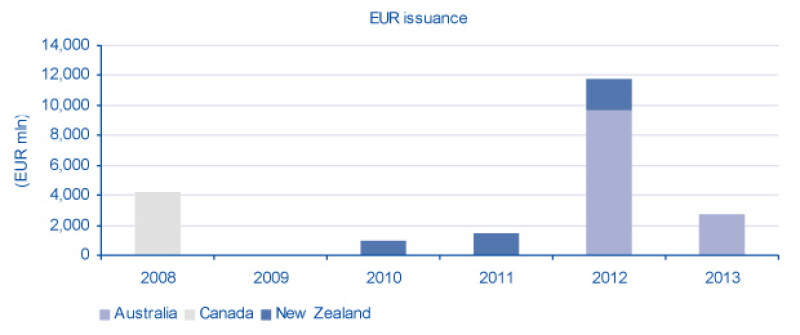
In our view, Basel III will be one of the key drivers for the globalisation of covered bonds, as they are set to become a very attractive asset class in new markets, such as Asia, which has a low level of sovereign debt. Covered bonds represent a welcome alternative to traditional high-quality liquid assets, such as government bonds. More than half of the global new issuance in 2012 was already accounted for by non-European issuers, with Australian banks being the most important issuers globally in 2012, following the approval of their specific legislation in 2011.
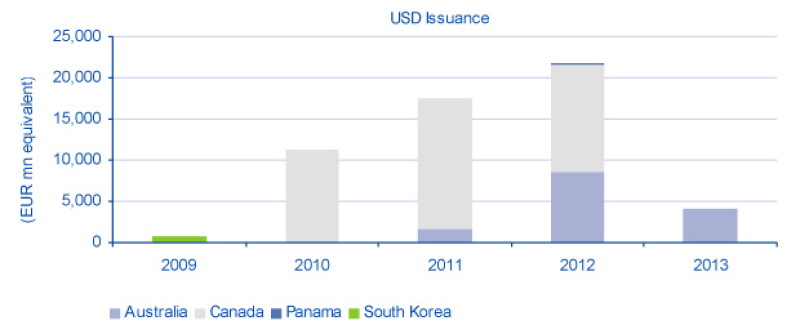
Figures 1 and 2 demonstrate the issued volume of covered bonds (public deals) in euros and US dollars by the most recently established non-euro covered bond programmes. Deals denominated in the former have been more common as issuers benefited from the shortage of US dollar paper in this asset class.
Figure 1: New non-European covered bond issuance activity in USD |
|
Source: Dealogic, BBVA Research |
Figure 2: New non-European covered bond issuance activity in EUR |
|
Source: Dealogic, BBVA Research |
Issuance activity from Canadian issuers has been negligible in 2013 as issuers have had to establish new programmes as the newly proposed legislation prohibits mortgage-insured collateral in the cover pools, in its quest to moderate lending volumes and dampen the increase in Canadian house prices. The Australian market has benefited from a sound sovereign position, generally strong credit profiles of its domestic credit institutions and the fact that the issuance has been based on a strong statutory and supervisory framework since its inception.
Canadian, New Zealand and Australian covered bonds have moved from a previously unregulated covered bond framework, to one where assets are held in a separate special purpose vehicle (SPV) and segregated from the issuer through a legal true sale between the issuer and the guarantor to assure their insolvency remoteness. These frameworks also introduce requirements on the quality and nature of assets to be included in the cover pool, as well as a minimum over-collateralisation requirement (with the exception of Canada, where issuers must establish the minimum and maximum coverage ratios). In addition, all these legislative frameworks coming from old unregulated structured contracts (including the UK) have included additional credit enhancement and investor protection on top of the legal or programmed over-collateralisation inherited from the former so-called structured programmes.
Asset encumbrance
The recurrent question arising from the introduction of covered bonds, which is answered differently from one country to another, is that an excessively high a level of protection for covered bond holders (asset encumbrance) may be to the detriment of customer deposits and senior unsecured bondholders in the event of the issuer's bankruptcy. In this regard, the clarification of the reach of covered bond holders' statutory claims during the resolution processes might be crucial for the investment decisions of economic agents in the market. Although rating agencies have not yet raised the red flag regarding asset encumbrance, these concerns were the reason why, in 2011, the South African bank regulator rejected the option to develop a covered bond framework. The covered bond structure was regarded as being materially inconsistent with the regulator's duty to protect depositors and would harm the established senior unsecured investor base.
In fact, most of the specific covered bond legislation approved in new markets in recent years or draft legislations have imposed a limit on the issuance of covered bonds versus the issuer's total assets, which balances the benefits of covered bond issuance against the impact on depositors and other unsecured creditors: Singapore (two percent), Canada (four percent), South Korea (four percent), Australia (eight percent) and New Zealand (ten percent).
Countries such as South Korea, Morocco, Singapore, India, Japan, Chile, Taiwan, Malaysia, Brazil, Mexico or the US, among others, have adopted, or are in the process of adopting, covered bond legislation, or are investigating the potential introduction of this funding tool, by drawing on best practice guidelines in established covered bond jurisdictions.
Covered bonds and Asia: The promised land?
South Korea is leading its Asian peers in setting up a statutory framework for covered bonds, aiming to boost financial stability by opening a long-term funding avenue for banks. So far, the state-backed mortgage lender, Korea Housing Finance Corporation, has issued several covered bonds under contractual legislation. It followed the best-practice rules recommended by the Financial Supervisory Service (FSS) in 2011 in terms of minimum total capital rations, eligible assets and issuance limits (four percent of the issuer's total liabilities).
The new covered bond law is likely to be fully effective by September 2013 and will include a minimum mandatory over-collateralisation level of five percent of the face value of the bond issuance and the capital, eligibility and issuance limit recommendations cited above. It will enable banks to issue legislative covered bonds directly as well as via the Korea Housing Finance Corporation. Issuing covered bonds could help banks manage interest rate risks as they seek to meet the FSC's target, which states that 30% of mortgage lending should be fixed-rate, amortising mortgages by 2016 (compared to 17% at present), so decreasing the amount of floating-rate mortgage products, which the authorities consider to be a source of instability.
The head of the People's Bank of China's financial stability bureau supported the idea that China should consider a trial programme to allow banks to issue covered bonds. In India, a working group has outlined an innovative framework for introducing structured covered bonds to India, using the country's National Housing Bank (NHB) as a SPV.
Singapore is the latest country in the region to consider jumping on the bandwagon. It recently held a consultation on allowing the issuance of up to two percent of the value of each bank's total assets, the most restrictive issuance limit imposed so far, while awaiting the finalisation of the Monetary Authority of Singapore's (MAS) proposed rules. Singapore's banks have predominantly deposit-funded balance sheets, limiting their wholesale funding needs. The MAS proposal reflects the approaches taken in the Australian Act and New Zealand's structured covered bonds (the SPV model). This includes a requirement that a cover pool monitor be appointed and bondholders relying on existing contractual and legal mechanisms, although it has set criteria regarding asset quality and monitoring of assets as well as a minimum over-collateralisation.
Covered bonds in Africa and the Middle East: Gaining momentum
Regarding the covered bond framework development in Africa and the Middle East, and after the setback in 2011 when South Africa rejected the introduction of a covered bond framework, Morocco is now in the front line to pass a draft law by late 2013. The law is currently under review. It would be Africa's first covered bond regime. Turkey has had dedicated covered bond legislation since 2011. The framework covers both mortgage-backed and SME-backed (the first country worldwide) covered bonds.
Morocco's covered bond legislation is mostly based on benchmarks drawn from the German Pfandbrief legislation (on-balance sheet framework) in terms of specific supervision, monitoring of the cover pool by an independent comptroller and implementation of prudential regulations on the cover pool. These rules include internal audit, risk management, and liquidity obligations. A specific cover pool manager will be designated in the event of bankruptcy and given sufficient power and tools to continue the management of the cover pool or to transfer it to another bank.
Turkey has adopted a different approach to the other new legislative frameworks. Legislation has focused on two different on-balance sheet covered bond classes, the traditional mortgage covered bonds and SME covered bonds (covered bonds backed by loans to small and medium sized enterprises),. It is the first country in the world to have a specific legislation for SME covered bonds. Issuance activity so far (Denizbank, Sekerbank) has been limited to only SME covered bonds issued in domestic currency and placed to European supranational and development agencies. Nevertheless, other domestic banks such as Garanti and Akbank have declared their intentions to issue mortgage covered bonds.
Covered bonds in LatAm: Development stalled
Covered bond developments in Latin America are still at a very early stage. The viability of the financing tool in Latin America depends on many factors, including the speed of regulatory reform, the legal strength of the security interest over the assets, as well as the emergence of a secondary mortgage market. Moreover, the additional cost for the issuers to eliminate, or at least carve out as much refinancing risk as possible by reducing any asset liability mismatch as well as the likely high levels of over-collateralisation required to elevate covered bond ratings above the counterparty's are still cost-prohibitive for issuers in comparison with other funding tools.
A number of Latin American countries have already passed, or are in the process of passing, covered bond laws, such as Argentina, Mexico, Chile, Peru and Brazil. However, due to the banks' efforts to grow their deposit base, the ease of issuing senior unsecured debt and the good traction of the residential mortgage-backed security (RMBS) market in countries such as Mexico, banks may still see little incentive to move toward covered bonds in the short term.
Panama's Global Bank issued the first ever covered bond in the region in October 2012 in US dollars using securitisation techniques, since Panama does not have a covered bond law in place. Banco Santander Chile is looking to issue the first ever covered bond from the Andean country in July, to support one of the most developed mortgage markets in the emerging economies. Nevertheless, the Chilean covered bond framework, put in place in September 2012, has some particular features that complicates an international placement. In particular, the fact that the issuance amount will be used to originate new mortgages within a period of up to 18 months after the placement of the bonds and there is little clarity on asset segregation in case of issuer default and lack of liquidity provisions to ensure interest and principal payments due on the bonds following an issuer default.
Finally, developments in Brazil of covered bond-like instruments remain stalled despite the combination of falling interest rates, a growing middle class, an inadequate mortgage market structure and issuer appetite. Domestic banks have the legal requirement to channel 65% of saving deposits into mortgage lending, and in addition, Caixa Economica Federal (CEF), the government-owned bank, which has a 75% share of the residential mortgage market, has access to funding at advantageous conditions and has no need to issue covered bonds. Likewise, Mexican law prohibits issuers from segregating assets for the benefit of a single call of creditors and the senior right of bondholders in the event of bankruptcy also needs to be legally established. The good traction of the domestic RMBS market in terms of investor demand, ratings and funding cost is another hurdle for Mexican covered bonds to overcome.